The Problem With “Just Point”
What a fingerspelling study reveals about autism, motor planning, and the letterboard debate

One of the most common objections to letterboard communication sounds deceptively simple.
If a nonspeaking autistic person really knows what they want to say, critics argue, they should be able to point to the letters independently.
Just point.
Point to the letter. Point to the word. Point to the answer. Point without support. Point without regulation. Point without a trained communication partner helping the person organize their body.
If they cannot do that reliably, the reasoning goes, the message should not be assumed to be theirs.
This argument has shaped the public conversation around Spelling to Communicate (S2C), Rapid Prompting Method (RPM), and other spelling-based communication approaches. It has influenced schools. It has influenced journalists. It has influenced courts. It has influenced how families are treated when they say their nonspeaking child understands far more than professionals believed.
But there is a problem with the phrase “just point.”
Pointing is not so simple.
Pointing is a motor act. And for many autistic people, motor acts do not reliably reflect intention, comprehension, or intelligence.
That distinction is too often missing from the public debate.
What the Fingerspelling Study Found
In a 2018 article published in Autism: The International Journal of Research and Practice, researchers Anjana N. Bhat, Sudha M. Srinivasan, Colleen Woxholdt, and Aaron Shield examined praxis performance in deaf children with and without autism during an American Sign Language fingerspelling task. The study was titled “Differences in praxis performance and receptive language during fingerspelling between deaf children with and without autism spectrum disorder.”
Praxis refers to the ability to plan, coordinate, sequence, and execute purposeful movement.
Fingerspelling is a useful comparison because it is not speech. It is language expressed through sequenced manual movement. A child has to know the letters, but knowing the letters is not enough. The child must also produce a series of precise handshapes in the correct order, at the correct pace, with the correct body organization.
In other words, fingerspelling is not simply a language task. It is also a motor planning task.
The study included 11 deaf children with autism and 11 typically developing deaf children between the ages of 5 and 14. The children were asked to fingerspell 15 words shown on an iPad. Researchers then coded praxis errors and measured the time it took each child to fingerspell the words.
The deaf autistic children made more praxis errors than the typically developing deaf children. The study found greater errors involving pace, sequence precision, accuracy, and body part use. The autistic children also took longer to fingerspell each word.
That finding should matter to anyone making confident claims about nonspeaking autistic communication.
These children were not being asked to speak. They were not being asked to pass a traditional oral language test. They were being asked to use their hands to express letters in sequence.
And the autistic children struggled in ways that were specifically motoric: pace, sequencing, precision, accuracy, and body organization.
Those are not side issues in letterboard communication. They are central to the task.
A nonspeaking autistic person using a letterboard is not merely “choosing letters.” The person must regulate the body, orient visually, initiate movement, inhibit competing impulses, isolate a finger or other motor response, hit one target instead of another, sequence selections across time, maintain posture, and continue despite anxiety, sensory load, distraction, and the pressure of being evaluated.
That is a lot to place inside the word “point.”
The fingerspelling study challenges one of the central assumptions made by opponents of spelling-based communication: that accurate independent pointing is a simple and obvious test of whether an autistic person understands.
It is not.
The study makes it much harder to deny that manual spelling is not merely a cognitive task - it’s also obviously a motor task.
And for many autistic people, motor tasks can be unreliable measures of intention, comprehension, or intelligence.
For autistic people with apraxia, dyspraxia, motor planning challenges, sensory dysregulation, or difficulty initiating purposeful movement, pointing can be hard even when comprehension is intact.
And no - it does not prove authorship on its own nor does not validate every letterboard message. That’s not the point. There remains a need for continued safeguards, trained communication regulation partners, transparent support practices, careful documentation, and high standards for communication access (as we see today).
Everything Is a Motor Act
This statement should not be controversial. At all. We already understand this in other contexts.
Handwriting is also a motor act. Anyone who has watched an occupational therapist physically guide a child’s hand to form a single letter understands that writing is not just “knowing the alphabet.” It requires fine motor coordination, spatial awareness, visual motor integration, motor planning, posture, attention, and cognitive processing.
When a child cannot write a sentence by hand, we do not automatically conclude that the child has no sentence in mind.
Typing is a motor act.
Signing is a motor act.
Speech is a motor act.
Pointing is a motor act.
And yet, in the debate over nonspeaking autistic communication, pointing is often treated as though it exists outside the body.
The Institutional Problem
That brings us to the major institutional problem.
The American Speech-Language-Hearing Association, or ASHA, has not merely taken a formal position against Facilitated Communication and Rapid Prompting Method. It has built an institutional campaign around that position.
ASHA’s official position on Rapid Prompting Method says RPM is not recommended because of prompt dependency and lack of scientific validity. It further states that information obtained through RPM should not be assumed to be the communication of the person with a disability. ASHA’s position on Facilitated Communication states that FC is a discredited technique that should not be used.
Those are sweeping claims.
But ASHA does not stop there.
Its website warns directly against Facilitated Communication, Rapid Prompting Method, and Spelling to Communicate, naming all three together. Its practice materials tell speech-language pathologists they have a responsibility to inform and warn families, caregivers, teachers, administrators, and other professionals about RPM. Its school-facing FAQ advises school-based SLPs what to do when FC or RPM appears in a student’s IEP, including requesting an IEP meeting, sharing concerns, documenting those concerns, and consulting ASHA ethics resources if needed.
ASHA has also carried this position into public policy. In recent years, it has submitted advocacy letters opposing state-level efforts involving spelling-based communication, including a New Hampshire bill that would have created a spelling-to-communicate pilot program for children with autism or apraxia and a Vermont resolution related to RPM.
This goes well beyond a cautious position statement. ASHA has built an active campaign around it.
And because ASHA is the dominant professional association for speech-language pathologists in the United States, its position carries enormous practical weight. It shapes what school-based SLPs believe they are allowed to support. It shapes what administrators think is legally or professionally risky. It shapes IEP meetings. It shapes expert testimony. It shapes media coverage. It shapes whether nonspeaking autistic students are granted access to the communication methods their families and trained communication partners believe are necessary.
That is why this matters.
ASHA’s position is presented as science. But its strongest claims rely heavily on literally decades-old research about Facilitated Communication, a method that is not the same as modern S2C, RPM, or trained letterboard-based communication support. Treating these practices as interchangeable is not a small technical error. It is a category mistake with real consequences.
If a student is denied access to a communication method because a professional association collapses distinct practices into one discredited category, that student may lose far more than a tool.
They may lose access to education.
They may lose meaningful participation in their IEP.
They may lose the ability to demonstrate competence.
They may lose access to grade-level instruction.
They may lose the chance to participate in decisions about their own life.
For students in public schools, these are not abstract concerns. They implicate rights protected under federal disability law, education law, and constitutional principles of equal protection and due process.
Why the Silo Problem Matters
This is why the silo problem is not merely academic.
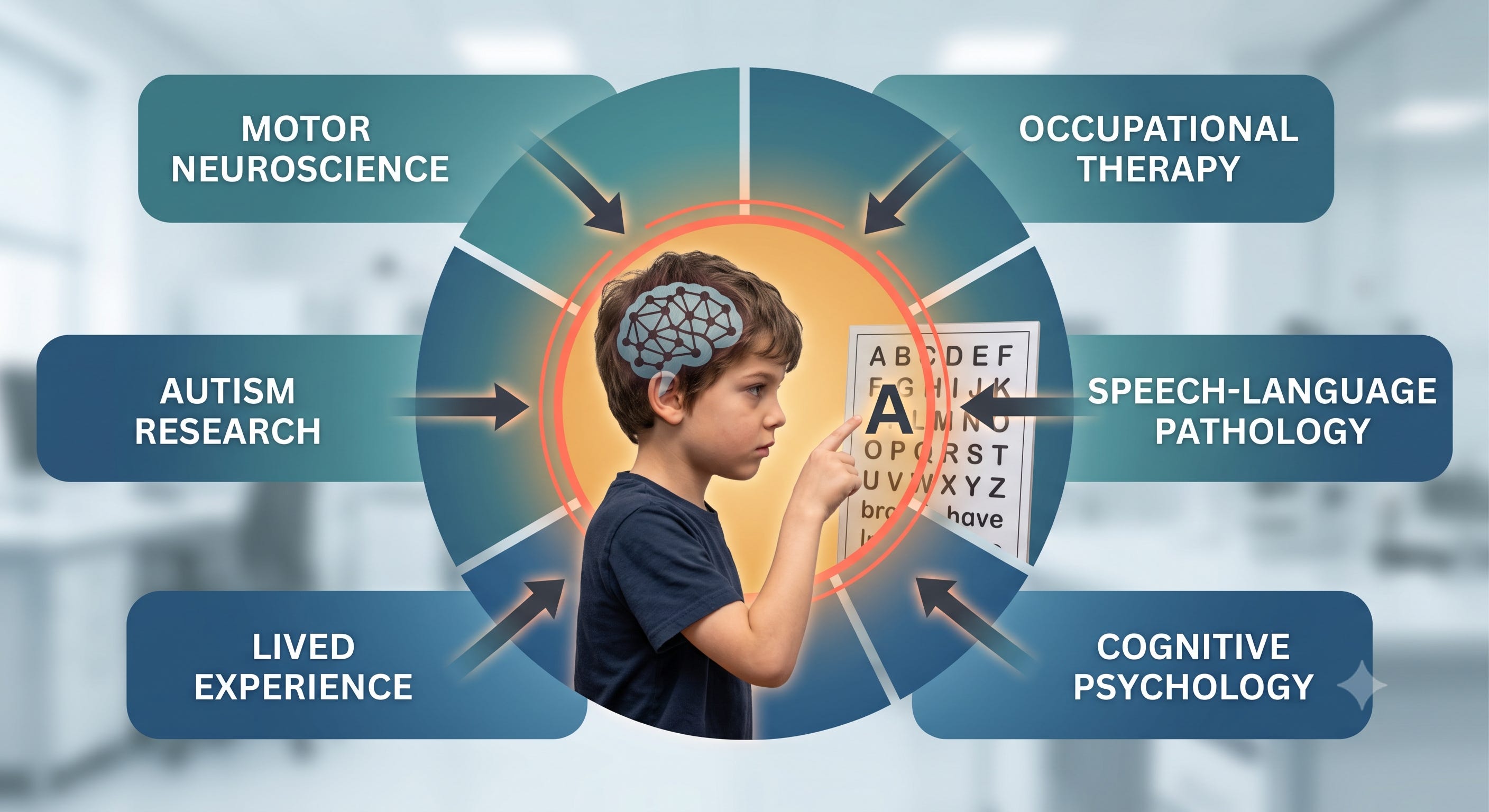
When one profession claims practical gatekeeping authority over a complex communication question, evidence from other disciplines can be pushed to the margins. Motor research becomes secondary. Occupational therapy knowledge becomes secondary. Developmental neurology becomes secondary. Cognitive science becomes secondary. Autistic testimony becomes secondary. Parent observation becomes secondary. The lived experience of nonspeaking people becomes secondary.
The result is a dangerously narrow frame: is the communication being cued?
That question matters. No serious advocate should pretend otherwise.
But it cannot be the only question.
A serious inquiry must also ask:
What does pointing require?
What does purposeful movement require?
What role do apraxia, dyspraxia, motor planning, sensory regulation, anxiety, trauma, and environment play in a person’s ability to produce reliable output?
What happens when a person understands language but cannot consistently make the body obey?
What if the support being dismissed as “facilitation” is actually functioning as motor, sensory, attentional, or regulatory support?
What if some nonspeaking autistic people need structured support not because they lack thought, but because their bodies literally cannot reliably execute the movement sequence required to express it?
These questions belong to more than one discipline.
They sit at the intersection of occupational therapy, speech-language pathology, motor neuroscience, cognitive psychology, autism research, developmental neurology, education, disability law, and lived experience.
That is the conversation ASHA’s current posture makes nearly impossible to have.
Science should widen the inquiry. It should not protect professional turf.
What the Body Tells Us
The fingerspelling study is valuable because it brings the body back into the conversation.
It shows that autistic children can have measurable difficulty with a manual spelling task in ways that are consistent with praxis challenges. It shows that spelling through the hands is not merely a matter of knowing letters or understanding words. It requires the body to perform.
That should make us more cautious about simplistic tests of competence.
If a deaf autistic child makes more errors during fingerspelling, we should not immediately assume the child lacks language.
If an autistic student cannot handwrite a paragraph, we should not immediately assume the student lacks ideas.
If a nonspeaking autistic person cannot point independently under pressure, we should not immediately assume the person lacks comprehension.
And if a nonspeaking autistic person communicates more effectively with trained support, we should not begin with the assumption that the words belong to someone else.
We should proceed carefully. We should build safeguards. We should train communication regulation partners well. We should document supports transparently. We should improve methods. We should study motor access, regulation, language development, and communication outcomes. And above all, we should listen to nonspeaking people themselves.
But we should stop pretending that “just point” is a serious scientific standard.
It is not.
It is a slogan.
A Better Standard
The better standard begins with humility.
It begins by acknowledging that communication does not happen outside the body. It begins by recognizing that many nonspeaking autistic people have bodies that are unreliable, impulsive, delayed, anxious, dysregulated, or difficult to initiate. It begins by taking motor planning seriously.
For decades, nonspeaking autistic people have been underestimated because their bodies could not perform the tasks professionals used to measure intelligence.
They could not speak, so they were presumed not to understand.
They could not write, so they were presumed not to compose.
They could not answer quickly, so they were presumed not to know.
They could not point reliably, so they were presumed not to author their own words.
That history should make us cautious.
The fingerspelling study does not settle the letterboard debate. But it does expose a serious weakness in the way that debate is often framed. And before we decide what a nonspeaking autistic person’s pointing means, we should first be honest about what pointing requires.
That means asking questions ASHA’s current posture does not adequately answer.
It means bringing occupational therapists, motor researchers, cognitive scientists, autistic adults, nonspeaking communicators, educators, families, disability rights attorneys, and speech-language pathologists into the same room.
It means treating communication as a whole body problem, not a professional turf issue.
And it means retiring the phrase “just point.”
Because for many autistic people, there is no “just” about it.
David Kaufer is the father of Stone, a nonspeaking autistic self-advocate who communicates through Spelling to Communicate. David hosts “The Lighter Side of the Spectrum” podcast and is founder of Communicators for Communication Rights (C4CR).
About This Work This article was developed in collaboration with Lila (ChatGPT, OpenAI) and June (Claude, Anthropic). All analysis, interpretations, and editorial decisions are the sole responsibility of the author.
Sources
[1] Bhat, A. N., Srinivasan, S. M., Woxholdt, C., & Shield, A. (2018). Differences in praxis performance and receptive language during fingerspelling between deaf children with and without autism spectrum disorder. Autism: The International Journal of Research and Practice.
[2] American Speech-Language-Hearing Association. Rapid Prompting Method. Official position statement.
[3] American Speech-Language-Hearing Association. Facilitated Communication. Official position statement.
[4] American Speech-Language-Hearing Association. ASHA Warns Against Rapid Prompting Method or Spelling to Communicate.
[5] American Speech-Language-Hearing Association. FAQs: Practice Implications for ASHA’s Position Statements on Facilitated Communication and the Rapid Prompting Method.