The Wrong Question
Iatrogenic Communication Barriers: A Question Communication Science Has Barely Asked

Imagine a child develops a persistent cough. A physician mistakenly concludes it’s caused by allergies and prescribes antihistamines. Months later the child is still coughing, so additional allergy medications are added. The real problem, however, was never allergies. It was asthma.
The medications weren’t “bad”; they were simply being used to treat the wrong problem.
The greatest harm came not from the medications themselves, but from months spent treating the wrong condition while the real one (in this case, asthma) went unaddressed.
Medicine has long recognized that treatments can unintentionally contribute to illness or disability. This phenomenon is known as iatrogenic harm.
What if communication science deserves a similar framework?
A Question Worth Asking
We propose the concept of iatrogenic communication barriers as a framework for scientific investigation. By this, we mean communication barriers that may arise or become amplified unintentionally when interventions are based on an inaccurate understanding of why a person cannot reliably communicate.
Notice what we’re not saying. We are not arguing that all speech therapy is harmful. We are not arguing that all ABA is harmful. And we are not arguing that professionals intend to cause harm.
Instead, we’re asking a much more fundamental question: could years of intervention, based on an inaccurate understanding of why a person cannot communicate, unintentionally create additional barriers and their own kind of real harm? If the answer is yes, even for a subset of individuals, the implications are profound.
The Hypothesis We’re Testing
Every scientific investigation begins with a question. Most also begin with a hypothesis. Here is ours.
Hypothesis: When clinicians, educators, or therapists incorrectly identify the primary neurological barrier preventing a person from communicating (autism and not apraxia, for example), standard of care interventions (such as traditional speech therapy or behavioral intervention) may unintentionally delay effective communication access, reinforce inaccurate assumptions about competence, reduce educational opportunity, increase frustration, and contribute to long-term psychological, behavioral, or social consequences.
We refer to these potential unintended consequences as iatrogenic communication barriers.
This would not be a new phenomenon in disability research. In 1982, researchers Reiss, Levitan, and Szyszko named a related pattern in psychiatric diagnosis: “diagnostic overshadowing,” the tendency for a person’s real and separate symptoms, depression, anxiety, or undiagnosed medical condition to be attributed to their primary disability instead of investigated on their own terms.
Decades of subsequent research confirmed that clinicians reliably underdiagnose co-occurring conditions in people with intellectual disabilities for exactly this reason. If overshadowing happens in psychiatric diagnosis, there is no reason why it could not happen in communication assessment as well.
This is not a conclusion. It is a hypothesis that deserves careful scientific investigation.
Why This Matters
The greatest harm may come not from using the wrong therapy, but from treating the wrong problem entirely.
Imagine two children. Both understand far more than they can reliably express. Both struggle to speak or point reliably. The difference between them comes down to what gets diagnosed.
The first child is recognized as having significant motor planning challenges, difficulties documented in autism research since a 2007 study (Dziuk et al) linking dyspraxia to social and communicative deficits. Because the barrier is correctly identified as physical rather than cognitive, that child receives support built around the actual problem: alternative pathways for movement, age-appropriate content, and real opportunities to demonstrate what they understand. Given the right support, that child succeeds.
The second child is simply presumed incapable. No one goes looking for a motor barrier, so no one finds one. The absence of reliable speech or pointing gets treated as evidence of limited understanding rather than a clue that something else is going on. That child receives simplified instruction, repeated testing, lower expectations, and fewer opportunities to communicate, not because their underlying ability is any different, but because the correct diagnosis was never made. That child stays stuck.
Two children. Similar underlying abilities. One diagnosis found the actual barrier. The other never looked for one. Over time, that gap in diagnosis becomes just as consequential as the original neurological condition itself.
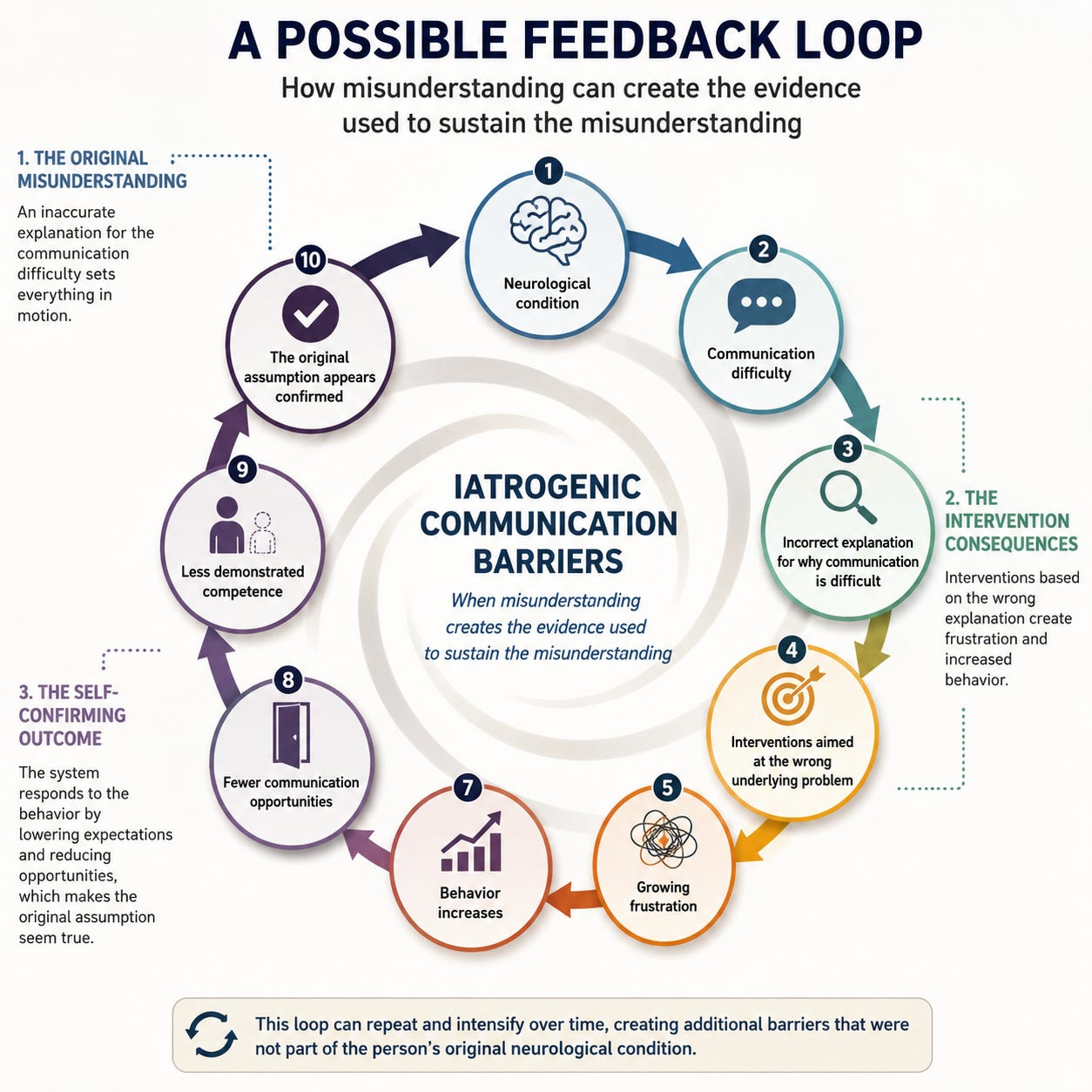
A Possible Feedback Loop
If our hypothesis has merit, the process might look something like this.
Neurological condition
↓
Communication difficulty
↓
Incorrect explanation for why communication is difficult
↓
Interventions aimed at the wrong underlying problem
↓
Growing frustration
↓
Behavior increases
↓
Expectations lowered
↓
Fewer communication opportunities
↓
Less demonstrated competence
↓
The original assumption appears confirmed
None of these steps require bad intentions. Teachers can care deeply, speech-language pathologists can work tirelessly, and parents can faithfully follow every recommendation, and the system can still produce the wrong outcome if the original explanation for the communication difficulty was incorrect from the start.
That possibility deserves serious scientific attention.
A Question Rarely Asked
Researchers have studied many of the individual pieces of this puzzle. Expectation effects have been documented since Rosenthal and Jacobson’s landmark 1968 work on teacher expectancy and the size of that effect has been debated ever since. A 1984 meta-analysis put it at roughly a tenth of a standard deviation, but the core finding, that reduced expectations produce reduced outcomes, has held up across decades of further research. Learned helplessness, first described by Seligman and Maier in 1967, showed that repeated exposure to outcomes a subject cannot control can suppress a capacity that remains fully intact underneath.
Motor planning differences have their own separate literature in autism research. Communication deprivation is recognized widely enough that the field built a formal Communication Bill of Rights around it in 1992. Trauma associated with repeated failure has its own literature in education and disability studies as well.
What has received far less attention is whether these factors interact over years to create additional communication barriers that were not part of the person’s original neurological condition. That is the question we believe deserves investigation.
Who Could Be Impacted?
This conversation extends far beyond any single communication method. It could affect nonspeaking and minimally speaking autistic people, and it could affect some individuals with Down syndrome, Angelman syndrome, and other neurological conditions that significantly impair speech or purposeful motor control. It also affects families, educators, speech-language pathologists, occupational therapists, physicians, researchers, policymakers, and anyone responsible for determining how communication is assessed and supported.
Most importantly, it affects the people whose voices may never be fully heard if we misunderstand the nature of their communication challenges.
The Questions We’ll Explore
This article isn’t meant to answer every question so much as introduce a framework. In the coming articles, we’ll explore questions that have rarely been examined together.
What happens when competence is underestimated?
What are the long-term consequences of misidentified competence?
Can repeated communication failure become communication trauma?
What is lost when meaningful communication access is delayed?
How does an exclusive focus on speech production influence long-term outcomes?
What happens when compliance is prioritized over autonomy?
What does the scientific literature actually say about the effectiveness and potential unintended harms of traditional communication interventions?
Each question deserves careful examination. Together, they may reveal patterns that have remained largely invisible because they have almost always been studied in isolation.
A Challenge to Researchers
If this hypothesis is correct, even for a subset of nonspeaking individuals, the implications are profound.
For decades, researchers have asked whether emerging communication approaches might produce unintended harms. That is an important question. We are asking for the same scientific curiosity to be applied to the established standard of care.
Could years of intervention, based on an inaccurate understanding of why a person cannot communicate, unintentionally create additional barriers and their own kind of real harm? Have those barriers been measured? If not, why not?
Until those questions are investigated, claims about the safety or superiority of any communication approach, including traditional speech therapy, remain conjecture.
The field has already agreed, formally, that every person has the right to a working communication system. What we’re asking is whether we’ve done enough to verify that the systems currently in place are working for the reasons we think they are.
Communication rights are about more than access to a particular method. They are about ensuring that every person is understood as accurately as possible before decisions are made that may shape the course of an entire life.
Sources: Reiss, S., Levitan, G. W., & Szyszko, J. (1982). Emotional disturbance and mental retardation: Diagnostic overshadowing. American Journal of Mental Deficiency, 86(6), 567-574. Rosenthal, R., & Jacobson, L. (1968). Pygmalion in the Classroom: Teacher Expectation and Pupils’ Intellectual Development. New York: Holt, Rinehart & Winston. Seligman, M. E. P., & Maier, S. F. (1967). Failure to escape traumatic shock. Journal of Experimental Psychology, 74(1), 1-9. Dziuk, M. A., Larson, J. C., Apostu, A., Mahone, E. M., Denckla, M. B., & Mostofsky, S. H. (2007). Dyspraxia in autism: association with motor, social, and communicative deficits. Developmental Medicine & Child Neurology, 49(10), 734-739. National Joint Committee for the Communication Needs of Persons with Severe Disabilities (1992, updated 2016, 2024). Communication Bill of Rights.
Communicators 4 Communication Rights (C4CR) is a communication rights organization founded by autism advocate David Kaufer, host of “The Lighter Side of the Spectrum” podcast. Our work focuses on communication rights, motor-based communication methods, and challenging assumptions about intelligence in nonspeaking individuals. David is the father of 20-year-old twins: his son Stone is a nonspeaking autistic self-advocate who communicates through motor-based typing, while Ty attends the University of Washington studying Political Science.
About This Work: This article was developed through collaborative research and writing with AI systems June (Claude, Anthropic) and Lila, a custom GPT built on ChatGPT (OpenAI). These AI collaborators assisted with research organization, argument structuring, and clarity refinement. All factual claims, interpretations, and strategic decisions remain the sole responsibility of the author.
If this framework resonates with your family, your classroom, or your practice, please share it. The next article in this series asks what happens when competence is underestimated.
As always…many thanks David. If your diagnosis is not correct your treatment is destined to fail.